
Economy: 1)Bank of Canada holds key rate steady in fifth consecutive decision; 2)Bank of Canada keeps key interest rate at 2.25% as it tries to balance competing economic risks; 3)(Updated) Too soon to call recession, rules Canadian authority on economic downturns; 4) BDC Monthly Economic Letter (and viewpoint on economy); 5) What’s happening in Ontario? (BDC); 6)Keep abreast of key economic indicators.
1)Bank of Canada holds key rate steady in fifth consecutive decision
Courtesy Barrie360.com and Canadian Press
By Craig Lord, June 10, 2026
The Bank of Canada held its benchmark interest rate steady in a fifth consecutive decision on Wednesday as it tries to support a turbulent economy without letting prices rise unchecked.
The central bank’s policy rate remains at 2.25 per cent after the hold, which was widely expected by economists.
Bank of Canada governor Tiff Macklem said in prepared remarks that the economy was weaker than expected in the first quarter of the year as U.S. trade policy and the war in Iran spur geopolitical uncertainty. Global oil prices – driven higher by the Middle East conflict – are meanwhile staying higher than first thought in the central bank’s April forecast.
“Against this backdrop, the Canadian economy has remained soft and inflation has increased,” Macklem said.
Annual inflation rose to 2.8 per cent in April, in part because of the global energy shock. The Bank of Canada now expects inflation to hold around three per cent in the coming months before easing back toward the central bank’s two per cent target.
Macklem said there has so far been “limited evidence” that higher energy prices are passing through into broader inflationary pressures.
He said the Bank of Canada will keep looking through the short-term rise in inflation tied to the oil price shock. He also reiterated the central bank will act to prevent price pressures from becoming entrenched.
The central bank is mandated to keep a lid on inflation but also tries to support the economy in the face of headwinds like U.S. trade aggression.
Competing pressures like these put the central bank in a dilemma, Macklem said.
“Raising rates to dampen inflation could further slow the economy. Easing rates to support growth increases the risk that higher inflation becomes persistent,” he said.
“For now, holding the policy rate unchanged balances those risks.”
Statistics Canada reported a slight contraction in real gross domestic product over the first three months of the year – a 0.1 per cent annualized decline, coming off a 1.0 per cent drop in the fourth quarter of 2025.
Those consecutive drops triggered debates about a recession hitting Canada, though many economists have pushed back on that narrative, arguing the modest nature of the decline doesn’t meet the bar for a recession.
Macklem said that recent economic data, including a strong May jobs report, signals the economy could rebound in the second quarter of the year. He also noted the labour market has been volatile lately but looking through the “bumpiness” shows employment is fairly flat so far in 2026.
2)Bank of Canada keeps key interest rate at 2.25% as it tries to balance competing economic risks
Central bank was largely expected to not change rate
Courtesy: CBC News
Abby Hughes, CBC News, June 10, 2026
The Bank of Canada held its key interest rate at 2.25 per cent on Wednesday, as the bank seeks to balance economic turbulence while keeping inflation from rising too much.
The decision marks the central bank’s fifth consecutive rate hold, as a number of factors have complicated the economic picture.
The central bank noted that the ongoing war in the Middle East, which has raised energy prices, has contributed to inflation, making life more expensive for Canadians.
But there has been “limited evidence” of high energy costs being passed through to consumer prices more broadly, according to the bank.
“Governing Council is continuing to look through the war’s near-term impact on headline inflation but will not let higher energy prices become persistent inflation,” the central bank said in its rate announcement.
During a press conference following the release, Bank of Canada governor Tiff Macklem said that the longer oil prices stay high, the more likely it is that those costs bleed into the general economy, which would require the bank to change rates in response.
Canada’s overall inflation rate in April rose to 2.8 per cent, and Macklem added the bank expected it to hover around the three per cent mark before gradually easing towards the two per cent target.
Balancing risks
Although Canada’s unemployment rate fell to a five-month low in May as hiring strengthened, Macklem said the figures have been volatile month to month, and there has been little net change in jobs since January.
General economic weakness and rising inflation create a tricky situation for the central bank, Macklem noted in his prepared remarks. Raising the interest rate to keep inflation at bay could cause further economic slowing, while lowering the rate could make inflation worse.
“For now, holding the policy rate unchanged balances those risks,” Macklem said.
That means the bank will be watching the key factors driving uncertainty and inflation — the trade war with the U.S. and the war in the Middle East, respectively — with a close eye, in case factors change that require rate moves in either direction.
A Reuters poll of 34 economists had expected the bank to sit on the sidelines, and more than 80 per cent predicted it would stay on hold throughout the year.
With files from Reuters
3)(Updated) Too soon to call recession, rules Canadian authority on economic downturns
Courtesy Barrie360.com and Canadian Press
By Craig Lord, June 5, 2026
The unofficial authority on recession calls in Canada says it’s too soon to use that word to describe the sluggish economy.
Debate has raged on Parliament Hill over whether the country is in a recession since Statistics Canada reported last week that the economy contracted for two quarters in a row.
The C.D. Howe Institute’s Business Cycle Council is traditionally viewed as the arbiter on calling a recession in Canada.
4) BDC Monthly Economic Letter (and viewpoint on economy)
Keep abreast of key economic indicators.
Is Canada in a recession?
The word “recession” is back in everyday vocabulary. And for good reason: on May 29, Statistics Canada confirmed that real GDP had declined by 0.1% on an annualized basis in the first quarter of 2026, following a revised contraction of 1.0% in the fourth quarter of 2025. Two consecutive quarters in the red. Technically, that’s a recession.
But before sounding the alarm, it’s worth taking a closer look. Because there’s a significant gap between the headlines and the reality on the ground. The Canadian economy isn’t collapsing. It’s slowing down. And the distinction is far from superficial.
One word, two very different realities
There are two ways to talk about a recession, and they don’t describe the same thing at all.
The first is a “technical recession.” It’s a purely mathematical criterion: two consecutive quarters of negative real GDP growth. It’s simple, it’s clear, and it’s exactly what the numbers show right now. But this rule says nothing about the depth, composition, or duration of the slowdown. In fact, on a non-annualized quarterly basis, first-quarter GDP was essentially unchanged at 0.0%. Very small movements become dramatic when annualized. The economy is struggling to gain momentum, but even the term “technical recession” is an overstatement to describe what is happening.
View and Enlarge the table
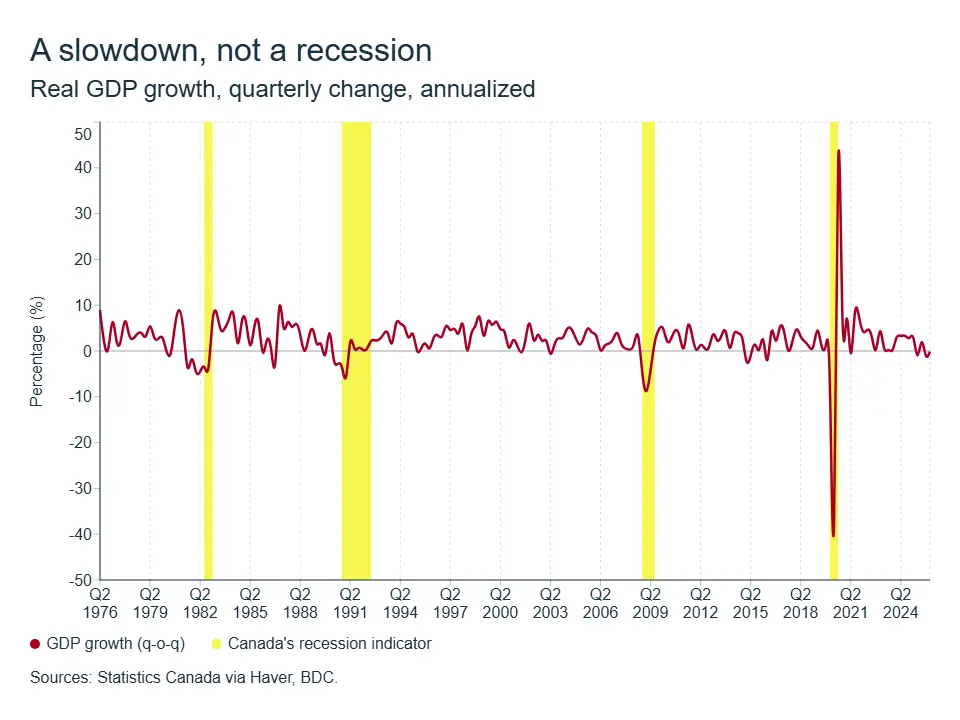
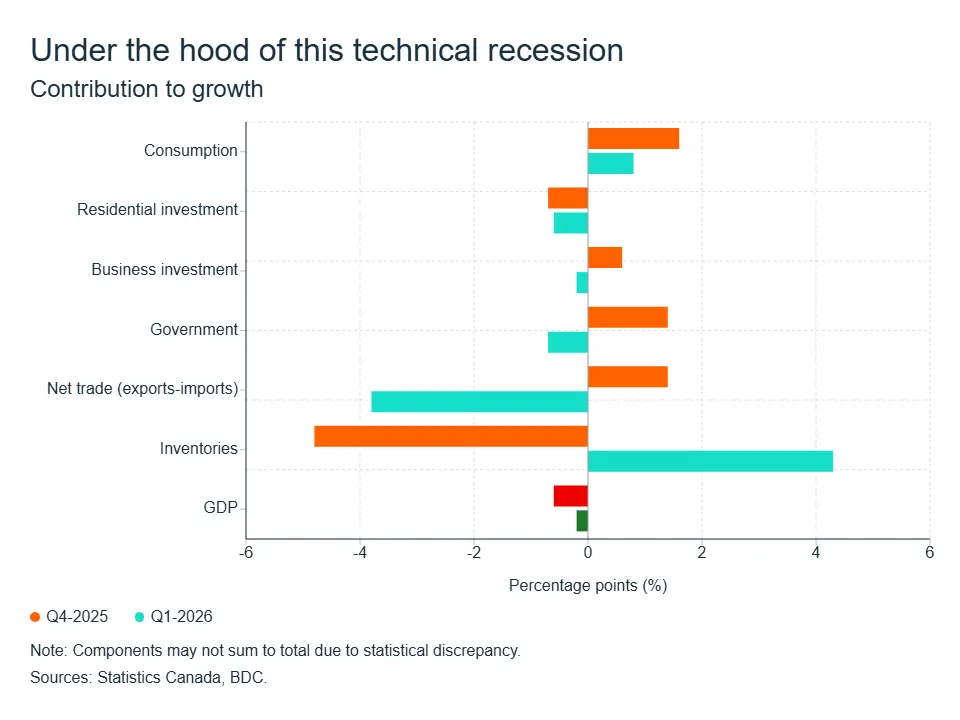
The second is a recession in the full sense of the term, as defined by the C.D. Howe Institute. This refers to a pronounced, persistent, and widespread decline in economic activity, measured primarily by GDP and employment. In a true recession, we witness the destruction of an economy’s productive resources— physical capital, machinery, and equipment all become underutilized. Workers facing long-term unemployment become discouraged and leave the labour market. Bank credit tightens across the board, and the country’s income declines permanently.
This is not what we are currently observing. The monthly layoff rate remains at 0.6%, perfectly in line with the pre-pandemic average, and the financial balance sheets of households and businesses show no signs of widespread distress. Canada is operating below its potential, to be sure. But its productive resources remain intact.
View and Enlarge the table
Under the hood: the five sources of growth
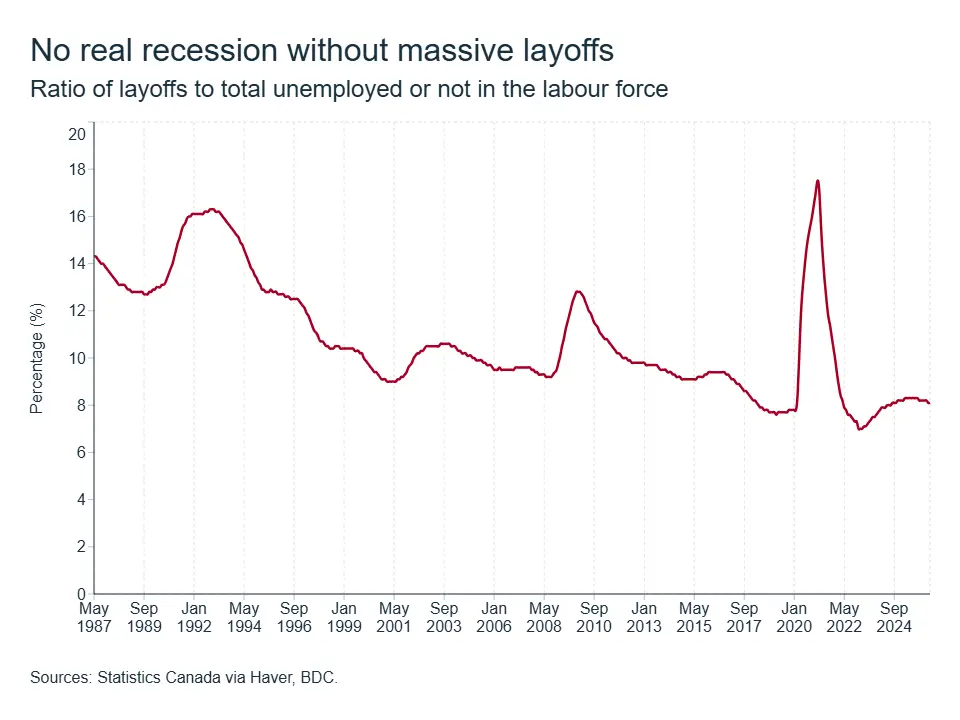
A single figure is not enough to make a diagnosis. Behind the overall change in GDP lie components pulling in opposite directions. Each component of growth plays a distinct role in predicting what the country’s economic future holds.
Household consumption remains the engine that’s still holding up
This is the most reassuring sign in an otherwise gloomy picture. Household consumption grew by 1.5% on an annualized basis in the first quarter, driven mainly by services, which grew by 2.0%, while increased spending on goods was more modest, at 0.7%. Consumption remains the main pillar of the country’s economic activity, and it is what is preventing the economy from sliding into a more severe downturn.
This observation is all the more significant given that it comes against an increasingly difficult backdrop for many households. The closure of the Strait of Hormuz has sent gasoline prices soaring, and food prices continue to rise; these pressures are directly squeezing the budget available for everything else.
View and Enlarge the table
Consumption is holding up, then, but the engine is weakening, with headwinds proving more persistent than expected. (We analyzed the outlook for households and business demand in the May economic letter).
Residential investment continues to weigh on growth
While consumption is the engine that’s holding up, real estate is the one that’s stalling—yet both depend largely on the same budget: household spending. Residential investment fell by 7.9% on an annualized basis in the first quarter, extending a streak of weak quarters. The decline was driven by a 9.9% drop in property transfer costs, reflecting a resale market that is struggling to recover.
The housing market landscape obviously varies from region to region. But overall, uncertainty and low consumer confidence are further slowing down major purchasing decisions. Canada’s population is also declining, which is dampening housing demand in the country compared to the record levels of recent years. Real estate therefore remains a drag on growth rather than a driver, and this is not likely to change in the short term.
Businesses continue to adopt a wait-and-see approach
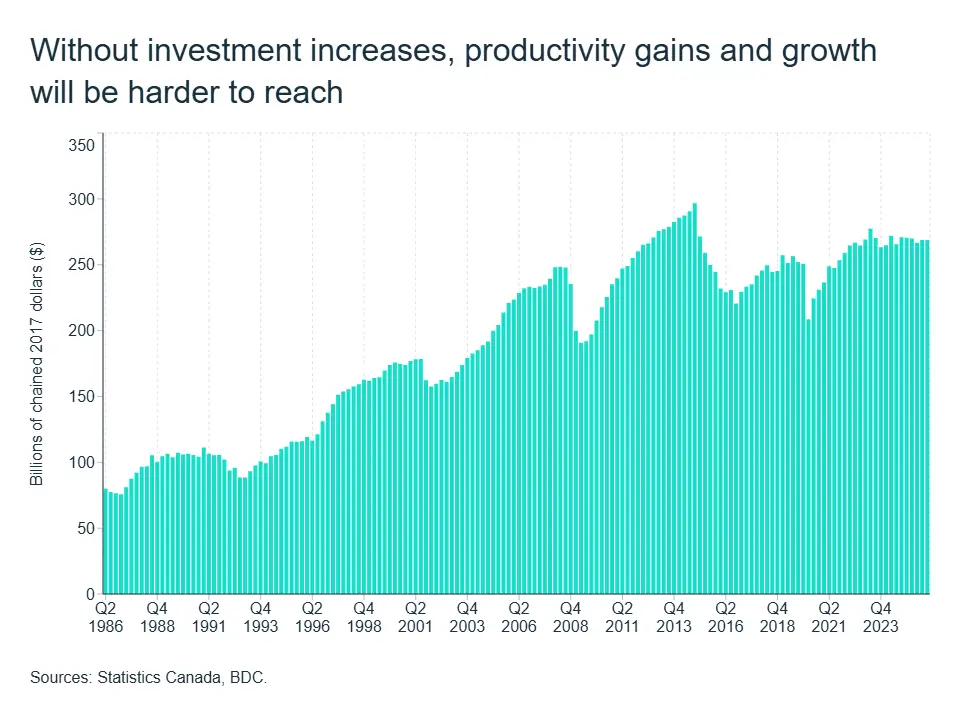
This is perhaps the most concerning factor for the country’s economic future. Business investment fell by 0.2% on an annualized basis in the first quarter. Unsurprisingly, businesses are in wait-and-see mode. Uncertainty surrounding tariffs, the review of the CUSMA scheduled for July 2026, and the conflict in the Middle East is prompting executives to postpone or cancel their investment plans.
This is concerning, as business investment is the foundation of productivity growth. But there is a crucial caveat: businesses are keeping the ship afloat. Productive capital isn’t being destroyed; it’s just on hold.
View and Enlarge the table
Government spending in a temporary slump
Public spending amplified the surprise weakness in GDP in the first quarter. Government consumption fell by 1.0% and public investment plummeted by 9.6% on an annualized basis. But this decline follows an exceptional surge of nearly 25% in the previous quarter.
Once again, we cannot conclude that the government is scaling back; we must understand what explains this decline. It is primarily a drop in spending on weapons systems following the high levels observed at the end of 2025. In short, it’s a simple technical correction.
This type of volatility could, in fact, become more frequent in the coming quarters as Canada accelerates its defense investments and supports major projects. This represents a significant injection of funds into the economy, but in a manner that could prove sporadic. Government spending is expected to once again become a positive contributor to growth as the year progresses.
Foreign trade remains the big unknown for economic growth
If we had to pinpoint a single culprit for the contraction in GDP in the first quarter, it would be foreign trade. Exports volume declined, driven by a drop in shipments directly affected by U.S. tariffs. On the other hand, imports surged.
About half of the increase in imports came from gold and scrap metal, movements that go hand in hand with companies building up inventories. Excluding these two categories, imports rose only minimally. The widening trade deficit is therefore largely inflated by product flows that fluctuate in response to tariff uncertainty and are highly sensitive to the unstable global environment.
It is a picture clouded by volatility, in which it is difficult to discern clear signals for the future.
The real diagnosis: an economy running at half speed
On a year-over-year basis, GDP growth has slowed almost continuously over the past year. This is a marked slowdown and should not be downplayed.
But the hallmarks of a deep recession are not present. The labour market still shows a negative balance for 2026 despite the addition of 88,000 jobs in May. The economy as a whole is not losing its productive capacity.
BDC’s economic team maintains its growth forecast at 1.0% for all of 2026. This pace is well below potential, confirming that the economy is moving at a slow pace, but it remains in growth mode and far from a worst-case scenario.
What this means for your business
5) What’s happening in Ontario? (BDC)
June 2026
Employment continued to grow in Ontario, with nearly 42,000 jobs added in May, following an increase of 42,500 in April. After a very slow start to the year, employment has risen sharply in recent months.
The construction sector is regaining momentum thanks to growth in the non-residential sector, driven by the acceleration of infrastructure projects by the Ontario government.
Employment in the manufacturing sector is also improving, driven by an increase in exports in recent months. Furthermore, the sharp decline in employment in the education sector appears to be stabilizing. After the initial shock of the significant drop in the number of international students, the sector seems to be in a better position.
Finally, the retail sector remains under pressure: employment continues to decline, despite growth in retail sales. It appears that the rise in oil prices over the past two months is putting significant pressure on this sector.
6)Keep abreast of key economic indicators.
June 2026
Taking a breather, yet resilient
The Canadian economy is not in a recession, but it is clearly struggling to regain momentum. The most recent monthly data paint a picture of an economy that has gradually lost speed. BDC maintains its growth forecast at 1.0% for 2026 as a whole.
Growth remains positive; it has simply slowed
At the start of 2025, the Canadian economy was still posting annual growth of over 2%. Twelve months later, in March 2026, that rate had fallen to 0.4%. The deceleration has been nearly continuous, with no real interim rebound. This is the sharpest slowdown since the onset of the pandemic in 2020.
This slowdown did not happen overnight. Instead, it reflects the impact of a series of successive shocks: trade uncertainty linked to U.S. tariffs and the revision of the CUSMA, the closure of the Strait of Hormuz, and rising energy and food prices. Adding to these shocks is a strong deceleration in population growth, exacerbated by demographic pressures. These headwinds eroded growth momentum one month at a time. Each new shock further limits the prospects for economic recovery.
The good news is that Statistics Canada’s preliminary estimate for April points to a significant rebound from March, which would bring the year-over-year change in real GDP to about 0.9%. If this figure is confirmed, it would mark the first significant acceleration since early 2025, signaling that the trough of the slowdown may have been reached. It is still too early to speak of a reversal of the trend, but the economy is at least showing that opportunities for growth still exist.
The real estate market remains stuck in a rut
Among the factors explaining this slowdown, the housing market plays a key role. Buying a home is a major financial decision. When uncertainty sets in, this is the decision people postpone first. And that is exactly what the data confirms.
In the fall of 2025, approximately 40,000 residential units were being sold monthly across the country. At that time, cuts to the Bank of Canada’s key interest rate had reignited optimism. Fast forward to April 2026, residential transactions fell to about 35,500 units, representing a decline of more than 12% in just six months and erasing nearly all of the recovery that began last year. Five-year fixed mortgage rates remain between 3.79% and 4.19% and are still high by recent historical standards.
Consumer confidence is shaken, as fear of job loss remains high according to the Bank of Canada, prompting many households to postpone major purchases such as home buying. Demographic decline is also easing pressure on housing demand compared to recent years. As long as these conditions persist, real estate will continue to weigh on growth rather than support it. The housing market landscape obviously varies from region to region.
Consumers are holding on, but inflation is weighing more heavily
While the real estate market is the leading indicator of confidence, retail sales volume is the indicator of purchasing power, and the signal they are sending deserves attention. After sustained growth in 2024, sales volumes have essentially plateaued since the beginning of 2025. The most recent months even suggest a slight slowdown.
This plateau is all the more telling given that sales in current dollars continue to show modest growth. In other words, Canadians are spending the same amount, but getting less for their money. Rising gas prices—exacerbated by the closure of the Strait of Hormuz—and accelerating food prices are directly squeezing the budget available for everything else.
The household savings rate, in fact, fell to 3.5% in the first quarter, a sign that consumers are drawing on their reserves to maintain their standard of living. Demand is not disappearing, but it is becoming more selective. Discretionary spending in particular—on dining out, leisure, and non-essential purchases—will be the first to have to offset the price increases affecting consumption of basic necessities.
Employment rebounded strongly in May
The labour market, which had been rather sluggish since the start of the year, offered an encouraging sign in May with a gain of 88,000 jobs. This marked the best monthly performance in nearly 18 months. The rebound comes after months of turbulence, which still leaves Canada 25,000 jobs short in 2026 compared to the December 2025 level.
The up-and-down trend of 2026 clearly reflects the nature of the current slowdown. Companies are not carrying out waves of layoffs, but they are hesitant. They are hiring based on order books and the conflicting signals they receive from the geopolitical and trade environment. The May rebound is an important reminder of the Canadian economy’s resilience. This result clearly shows that the Canadian labour market still has the capacity to create jobs in significant numbers—and even full-time ones!
However, we must qualify this. A single good month does not make a trend. And volatility itself is a sign of fragility. But combined with the improved outlook for GDP in April, May’s job gains reinforce the hypothesis that the outlook is improving in the second quarter. It is too early to declare that the economy is rebounding, but it shows that it still has some resilience.
The Impact on Your Business
The worst of the slowdown seems to be behind us, but the recovery will be gradual and uneven. Stay focused on financial discipline.
Your customers’ purchasing power is under pressure. Energy and food costs are eating into their budgets even before they walk through your door. Adapt your offerings and focus on value.
The job market is sending mixed signals, but one thing is clear: retaining your key employees remains your best investment. Training and retaining staff costs less than recruiting in a volatile market—and puts you in a better position when demand picks up, especially given that the population is shrinking.